Elicitation, specification, and traceability that holds together
Requirements
Systems engineer
Knows requirements like an INCOSE-certified systems engineer
Like the best requirements analyst you have worked with: hears what the customer means and writes requirements that can be tested.
The requirements exist, but in three documents with different versions. Which ones are inherited by the variant and which lack an owner is discovered at the review, or later.
What I take off your desk
Concrete work, not promises. Everything is a proposal; you approve.
What it looks like
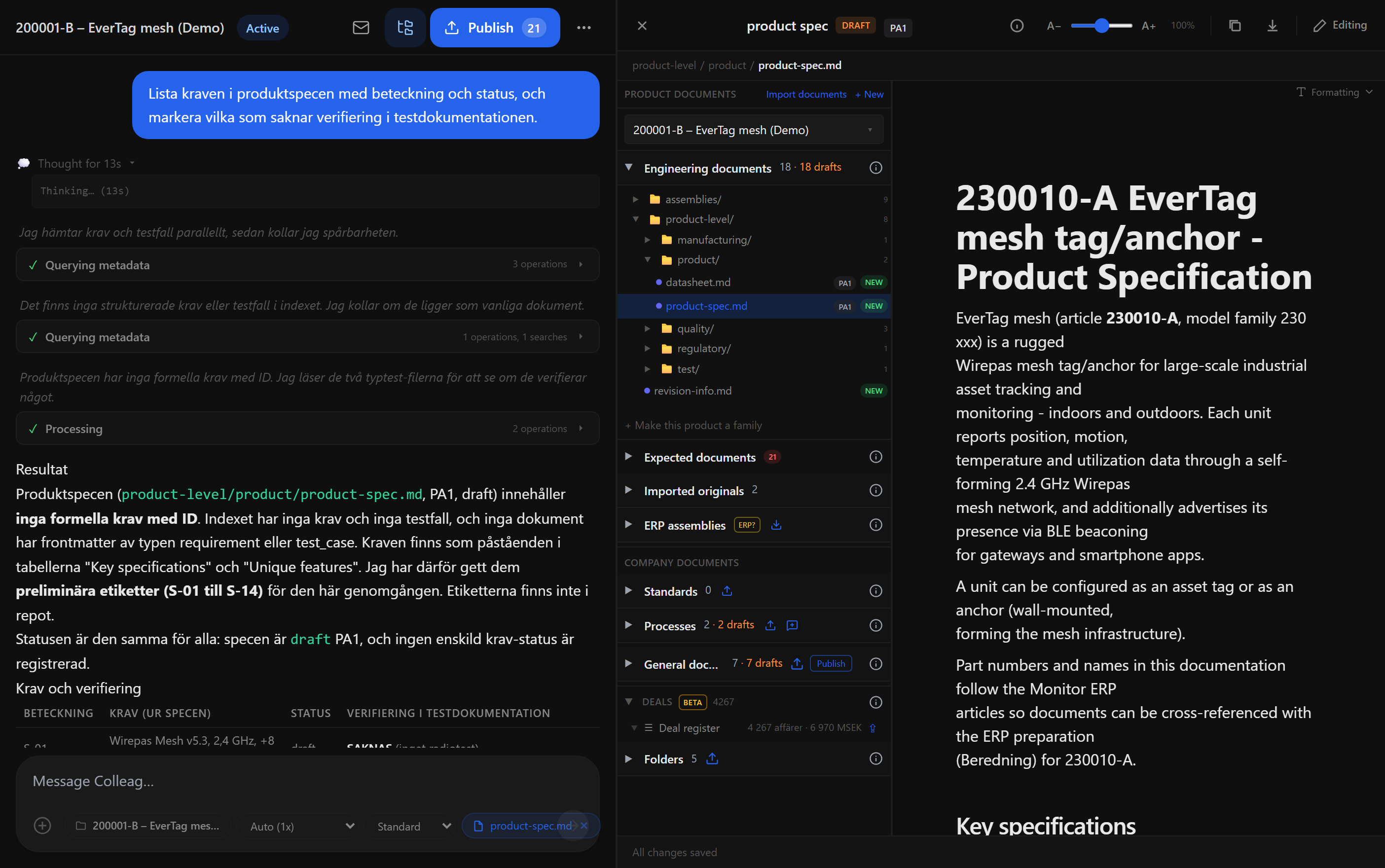
The product spec open alongside: requirements listed with preliminary labels, and verification status marked where missing.
From the day to day
Invented examples, but the form is real: a question, the material the colleague reads, and an answer with sources.
“The customer wants the X200 with an external stub antenna. Which requirements are inherited, and which lack an owner?”
The colleague reads the platform's requirement documents and answers with the requirements inherited by 310245, those that deviate for the variant and those lacking an owner or verification. The gaps are visible at project start, and the test engineer has a complete requirement list to plan the EMC test against.
Driven by
- Requirements that can be tested
- A requirement picture without contradictions
- Changes with known consequences
Measured on
How your digital colleagues work
The same rules for every colleague, built in from the start.
They know your business
The colleagues read your own documents and your own business data. No generic answers; your part numbers, your customers, your processes.
They propose, you decide
Every draft and every change goes through you or a flesh-and-blood colleague. Nothing is published without human approval.
Everything is traceable
Every document is a plain file in a version-controlled repository you own. You always see who changed what and why.
You are never locked in
All your knowledge can be exported at any time, in open formats. It is your data, not ours.
More colleagues in Product Development
Curious what it feels like?
We run pilot programs with a few manufacturing companies at a time. Tell us about your business and we will show what the colleagues can do with your documents and your data.