Quality
Risk analysis as support
FMEA pre-filled from documentation and earlier deviations, to show where testing is needed most.
How you work it in Colleag
- 1
Ask the colleague to prepare the FMEA material for the design.
- 2
The colleague reads the design documentation and earlier deviations on similar products.
- 3
Review in the team: you set numbers and actions, the colleague did the legwork.
- 4
Approve; the analysis is linked to the test needs.
A worked example
“Prepare FMEA material for the new charging circuit.”
An FMEA table with proposed failure modes from the documentation and your earlier deviations, ready to judge instead of an empty sheet. You set severity and action; the result points at where testing does the most good.
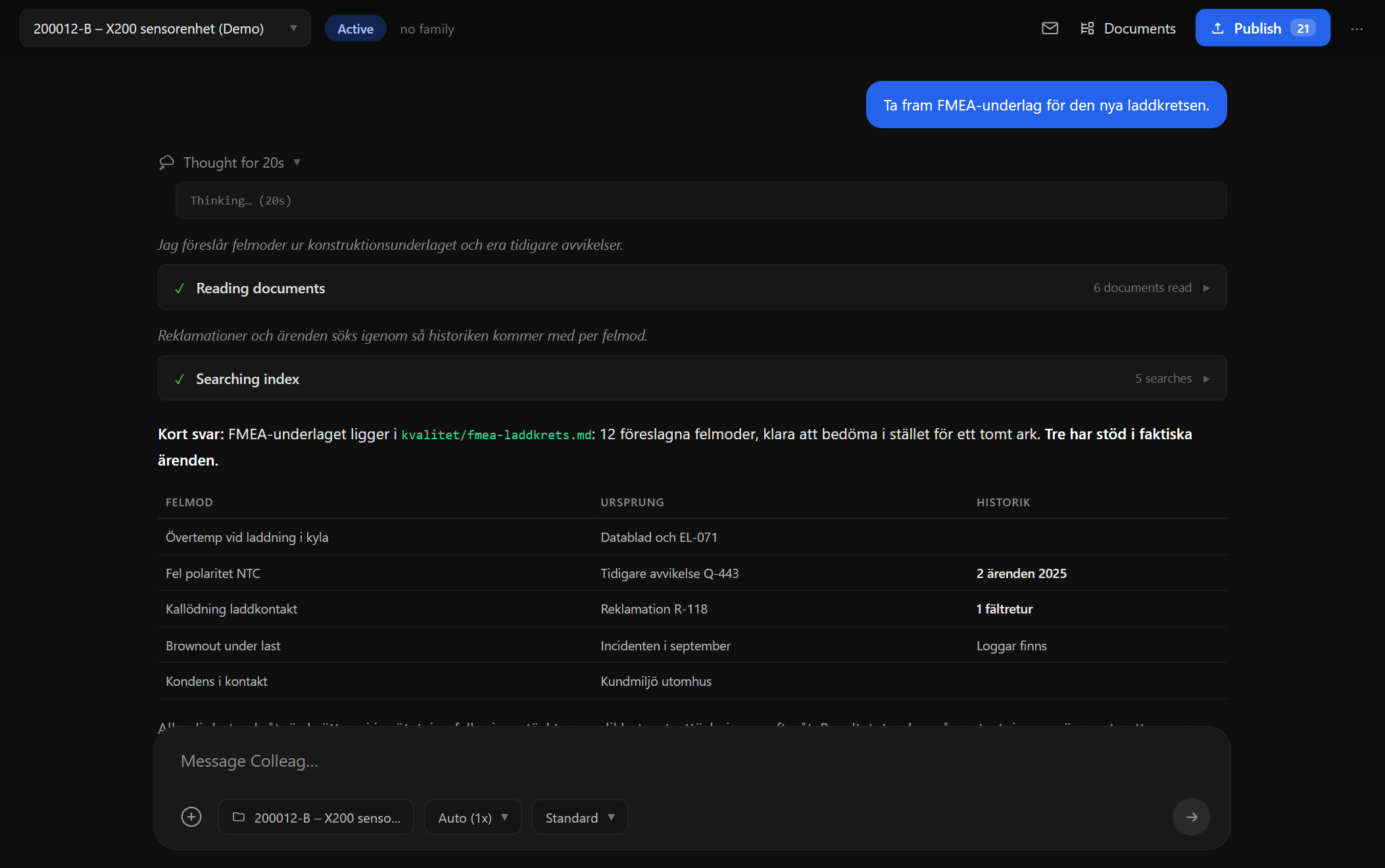
Screenshot from Colleag. The example uses invented figures.
The material
- The design documentation
- Earlier deviations and claims
- Your FMEA template
You approve
Everything the colleague produces is a proposal with sources. Nothing is published, sent or saved to the archive without a human approving it, and every figure traces to its material.
Curious what it feels like?
We run pilot programs with a few manufacturing companies at a time. Tell us about your business and we will show what the colleagues can do with your documents and your data.