Baselines, root-cause analysis, and continuous improvement
Production Engineering
PhD-level knowledge of production engineering
Like the best production engineer you have worked with: never settles for operator error as the root cause.
Improvement work drowns in firefighting. Deviations are investigated to the nearest explanation, not to the root cause. And without baselines there is no way to show whether last year's improvements achieved anything at all.
What I take off your desk
Concrete work, not promises. Everything is a proposal; you approve.
Baselines from your own data
Throughput, yield, and setup times from the ERP as a reference, so every improvement is measured against something real.
Structured root-cause analysis
Five whys and fishbones built on actual deviation data. I do not drop the analysis at the first convenient answer.
Follow-up that is not forgotten
After every improvement I check whether the effect held, three weeks and three months later.
Instructions that match reality
I flag work instructions that have drifted from how the job is actually done, before the gap becomes a deviation.
What it looks like
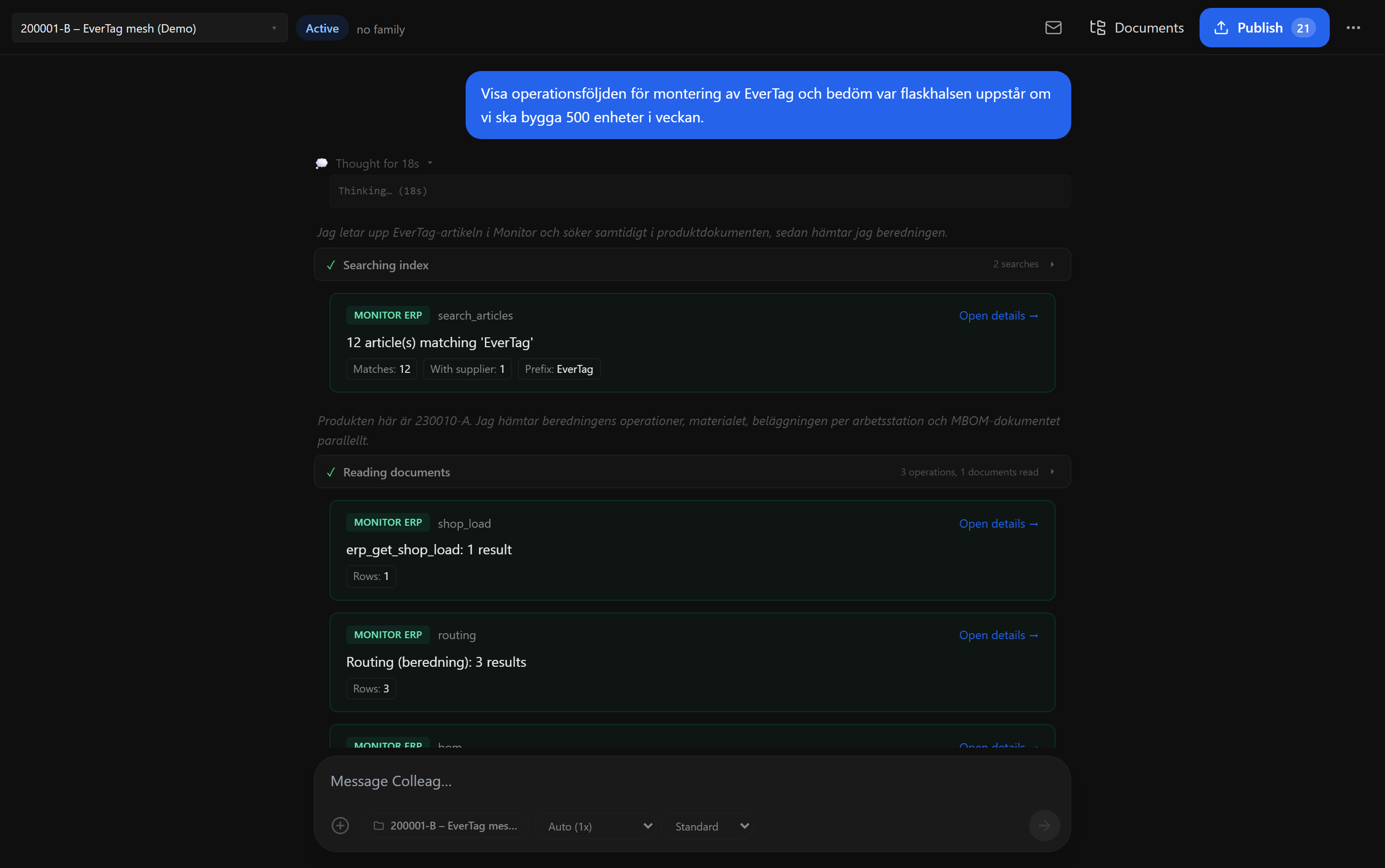
The assembly routing with an assessment of where the bottleneck appears at 500 units a week.
Driven by
- Stable processes with low variation
- Root causes, not symptoms
- Improvements that demonstrably hold
Measured on
How your digital colleagues work
The same rules for every colleague, built in from the start.
They know your business
The colleagues read your own documents and your own business data. No generic answers; your part numbers, your customers, your processes.
They propose, you decide
Every draft and every change goes through you or a flesh-and-blood colleague. Nothing is published without human approval.
Everything is traceable
Every document is a plain file in a version-controlled repository you own. You always see who changed what and why.
You are never locked in
All your knowledge can be exported at any time, in open formats. It is your data, not ours.
More colleagues in Operations
Curious what it feels like?
We run pilot programs with a few manufacturing companies at a time. Tell us about your business and we will show what the colleagues can do with your documents and your data.