Production Engineering
Pre- against post-calculation
The deviations per article and operation, with proposed updated times, so the calculations stop lying.
How you work it in Colleag
- 1
Ask the colleague to put pre-calculation against post-calculation for the articles.
- 2
The colleague reads planned and reported times per operation.
- 3
Review the deviations and the causes.
- 4
Update the times in the business system from the proposals.
A worked example
“Are the calculations right for the articles we ran this autumn?”
The deviation per article and operation: planned against reported time, biggest gaps on top and proposed new values. One-off deviating runs are separated from systematic errors.
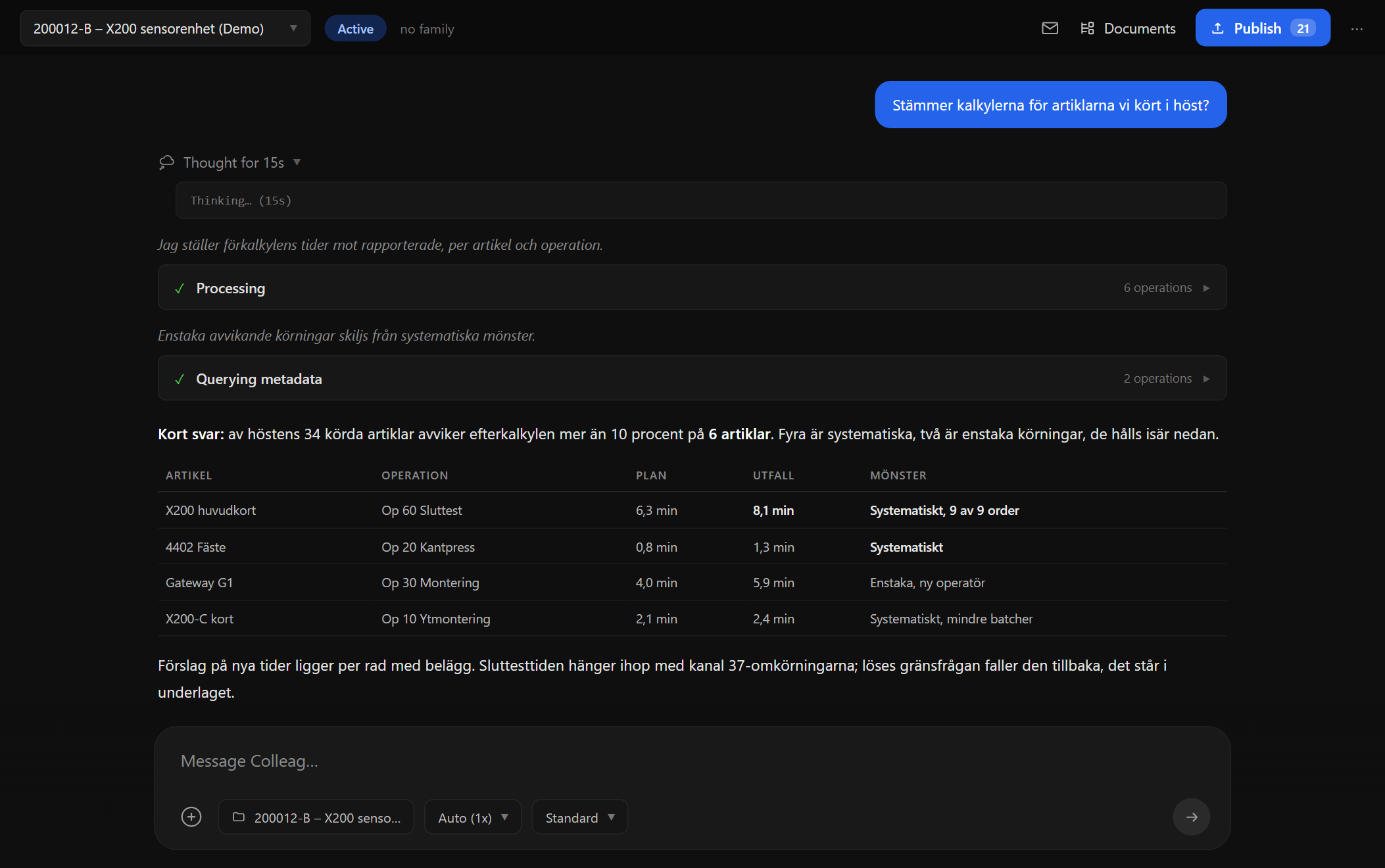
Screenshot from Colleag. The example uses invented figures.
The material
- The pre-calculations' times
- Reported times per operation
- The manufacturing-order history
You approve
Everything the colleague produces is a proposal with sources. Nothing is published, sent or saved to the archive without a human approving it, and every figure traces to its material.
More from Production Engineering
Curious what it feels like?
We run pilot programs with a few manufacturing companies at a time. Tell us about your business and we will show what the colleagues can do with your documents and your data.