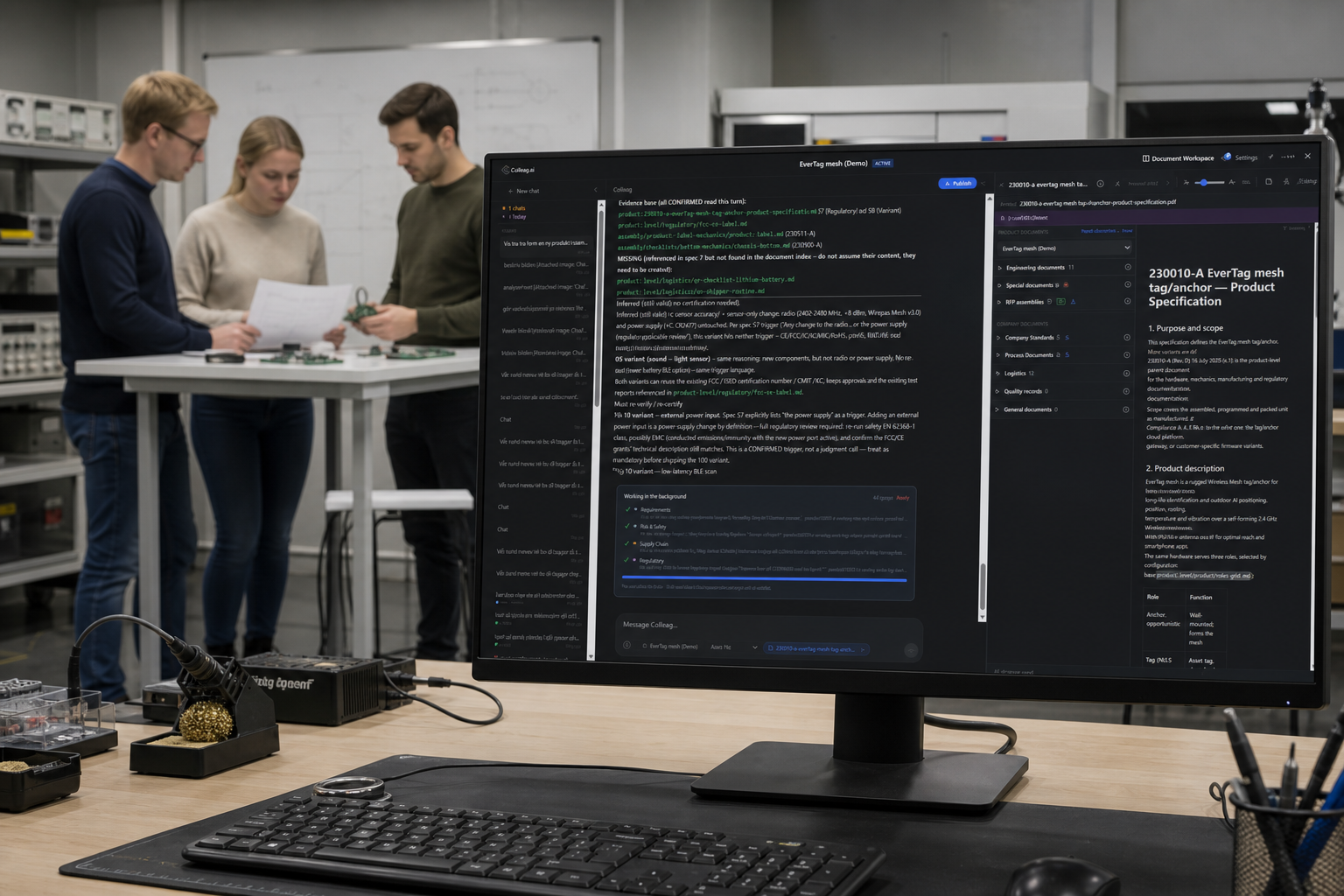
A variant is not a copy. It is a list of differences.
You already have a product that works. Now a relative needs to ship. The question is not “should we start over”. The question is which requirements, tests, purchase lines and labels actually change, and which can come along. Colleag.ai reads the base and shows the delta. You will recognise the folder named “_v2” that three months later no longer matches the original.
Intelligent reuse analysis
Delta documentation
Compliance inheritance
Manufacturing adaptation
Key benefits
- Clear reuse vs. redesign analysis
- Delta documentation instead of full duplication
- Compliance inheritance from base product
- Manufacturing process impact analysis
- Faster time-to-market for variants
Read more
How do you make a variant without copying the whole product in PLM and starting a new project? Colleag.ai reuses modules and shows what must change. ERP gets a new article. LCM often treats it as a new product. The project tool opens a new epic.
A variant should not mean copying the whole product in PLM and opening a new project. Colleag.ai reuses modules and shows what actually must change: requirements, test, purchasing, marking.
ERP gets a new article. LCM often treats it as a new product. The project tool opens an epic. Here “what is inherited, what breaks” is an answer against what already exists, not a new folder.
How this differs from ERP, PLM, LCM and project systems
- ERP
- A new article in ERP is easy. Knowing what can be reused is not.
- PLM
- A copy in PLM duplicates and then diverges.
- LCM
- LCM sees a new lifecycle. You wanted a delta against the base.
- Project management systems
- A new project for no reason. Here it is the same tree, different deltas.
What Colleag.ai does here that those systems do not
- Reuse what is true for both
- Documentation gaps for what differs
- No second truth in a copy