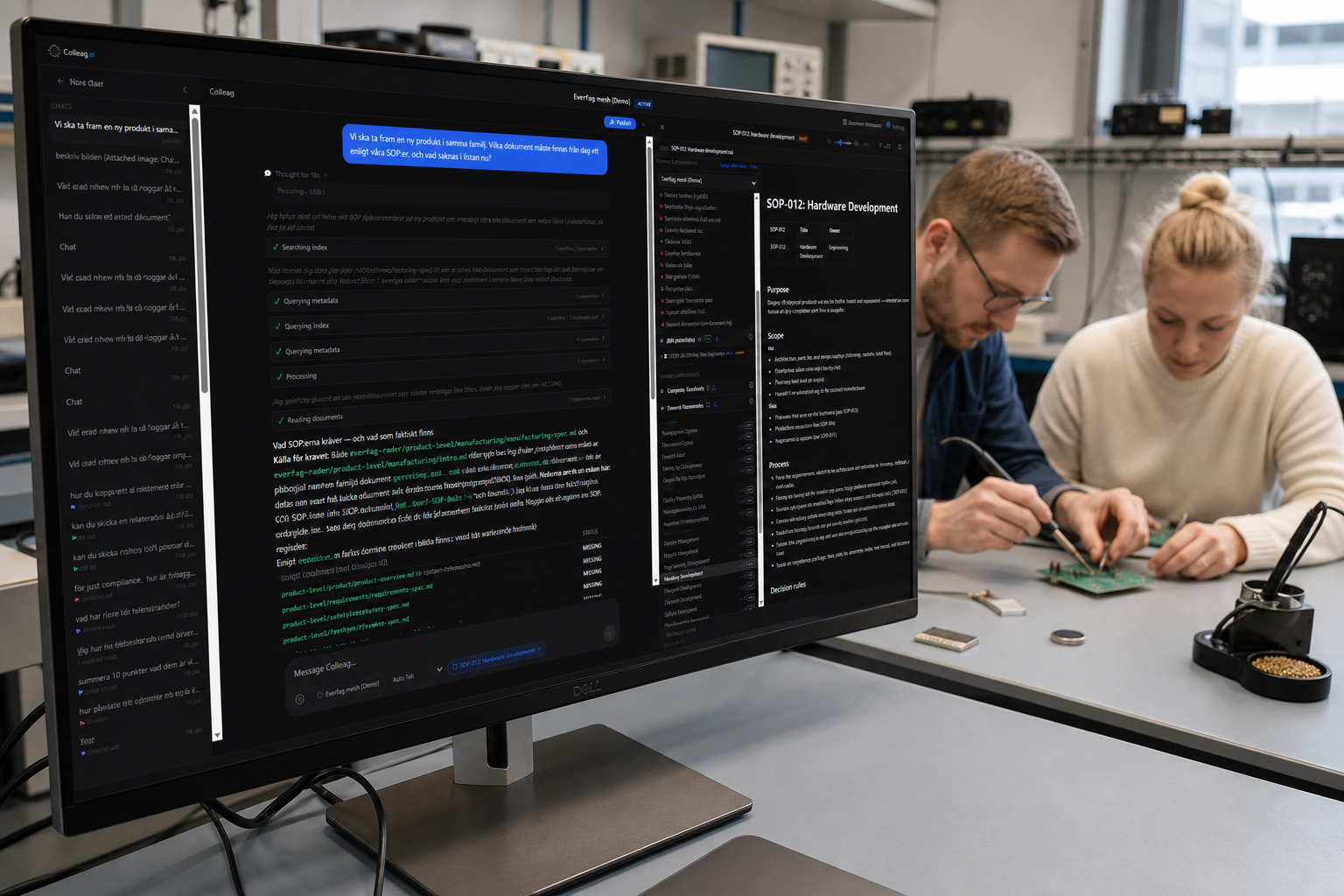
You know how you develop products. Colleag.ai gives you a structure to collaborate in.
In week one the drawing is rarely what is missing. What is missing is a shared picture of what must exist: overview, requirements, hardware and firmware specifications, test and purchasing. Without that picture, mechanics, electronics and firmware start in separate folders. Nobody sees the full scope. Colleag.ai reads your process documents and lays the product tree. Your colleagues get a structure to work in together. The AI colleagues get the same insight, and can help with what it takes to structure and produce what a complicated project actually needs. The structure is the first thing you get, not the last thing you clean up.
The process exists before the product does
Requirements capture across disciplines
Specification structure built as you design
Cross-discipline coordination from day one
Production-ready documentation
Key benefits
- Structured requirements from day one
- Specifications generated and maintained automatically
- Cross-discipline visibility throughout the project
- Documentation ready when the design is ready
- Full traceability from requirements to test evidence
Read more
How do you start new development when the product is not in Monitor yet and product data management (PLM) is empty? Colleag.ai runs against your process documents and templates from day one. The enterprise resource planning system (ERP) has no article. Lifecycle management (LCM) starts after release. The project tool has a kickoff without product knowledge.
New product work starts before the article exists in Monitor and before product data management (PLM) is filled. Colleag.ai runs against the process documents, how you bring up a product, so requirements and specifications do not wait for someone to create article 000000.
The enterprise resource planning system (ERP) has no article. Lifecycle management (LCM) starts after release. The project tool has a kickoff without product knowledge. What you get here is colleagues that already know how you work, not an empty wiki mixed with files from the International Organization for Standardization (ISO).
How this differs from enterprise resource planning (ERP), product data management (PLM), lifecycle management (LCM) and project systems
- ERP
- The enterprise resource planning system (ERP) gets the article later. The context must exist before that.
- PLM
- Product data management (PLM) fills when you have something to check in. The colleagues are already working.
- LCM
- Lifecycle management (LCM) is not a development tool.
- Project management systems
- The project plan is time. Requirements and specifications are Colleag.ai.
What Colleag.ai does here that those systems do not
- Process documents and agents before the first article exists
- Documentation that grows with the decision
- The same tree that later goes into in-service