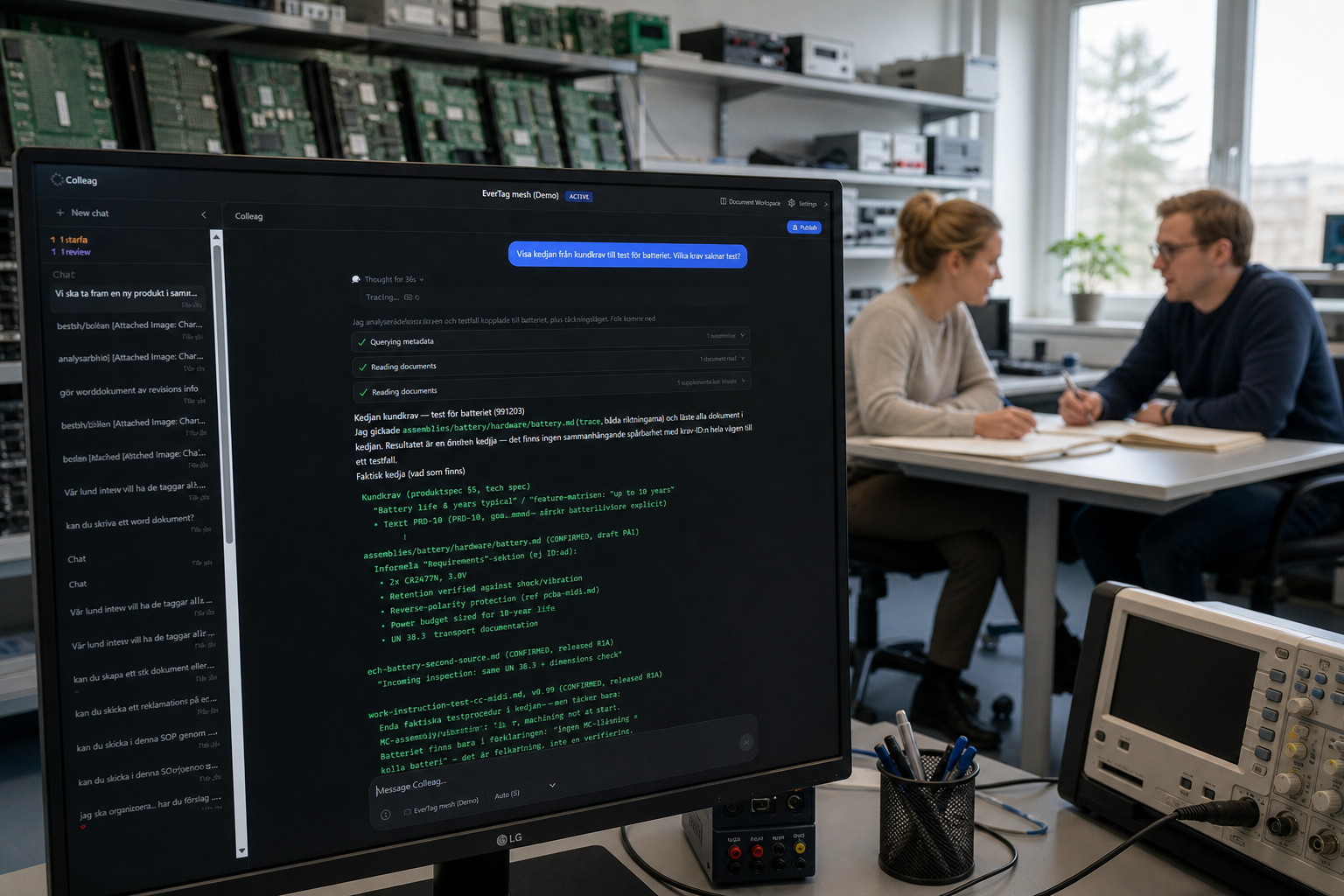
From customer requirement to test, without a broken chain.
You can point to the requirement. You can point to the test. What is missing is the link: does this case cover what the customer actually asked for, or only the NFC read while the battery requirement has no proof? Colleag.ai draws the chain and flags what has no test. You will recognise the 8D where someone writes “the requirement existed, but nobody ran it”.
The customer asked for one thing. The test measured another.
The chain should be kept while you build
When the requirement changes, downstream should show
Key benefits
- Automatic traceability from requirements through to verification
- Coverage gap detection across the full development chain
- Impact analysis when requirements change upstream
- Visual traceability matrices generated on demand
- Reduced risk of unimplemented or unverified requirements
Read more
How do you make sure a customer requirement reaches design, implementation and test, and that the chain can be shown? Colleag.ai keeps traceability in the documents, not in a separate ALM grid. ERP does not know the requirement. PLM may have a link. The project tool has user stories without a product chain.
Traceability that only lives in an ALM spreadsheet dies when nobody opens the sheet. Colleag.ai keeps the chain in the product files: customer requirement, spec, test, result. When the auditor asks, the chain can be shown without a documentation sprint.
ERP does not know the requirement. PLM may have a link from item to document. The project tool has user stories. None of them show that the test case still covers the clause the customer signed.
How this differs from ERP, PLM, LCM and project systems
- ERP
- ERP has no path from customer need to test result.
- PLM
- PLM sometimes links. It does not explain the chain in prose an auditor understands.
- LCM
- LCM versions. It does not prove coverage.
- Project management systems
- Stories in Jira are work. Traceability to the drawing is Colleag.ai.
What Colleag.ai does here that those systems do not
- Requirement to test in the same tree as the product
- A broken link shows as a gap, not a surprise
- Evidence you can produce in the audit