Hardware
Component choice against requirements
The datasheet against your spec, line by line, instead of a comparison in someone's head against the memory of a requirement.
How you work it in Colleag
- 1
Give the colleague the component and the question: is this good enough against our spec?
- 2
The colleague reads the datasheet and your requirement spec and puts them side by side.
- 3
Review the deviation list: every row points at where in the documents the fact stands.
- 4
Save the comparison as material for the design decision.
A worked example
“Is the alternative voltage regulator good enough against the main-board spec?”
A line-by-line comparison: voltage range, temperature, package and the parameters that deviate, with references to both datasheet and spec. Deviations are flagged instead of disappearing into an overall judgement.
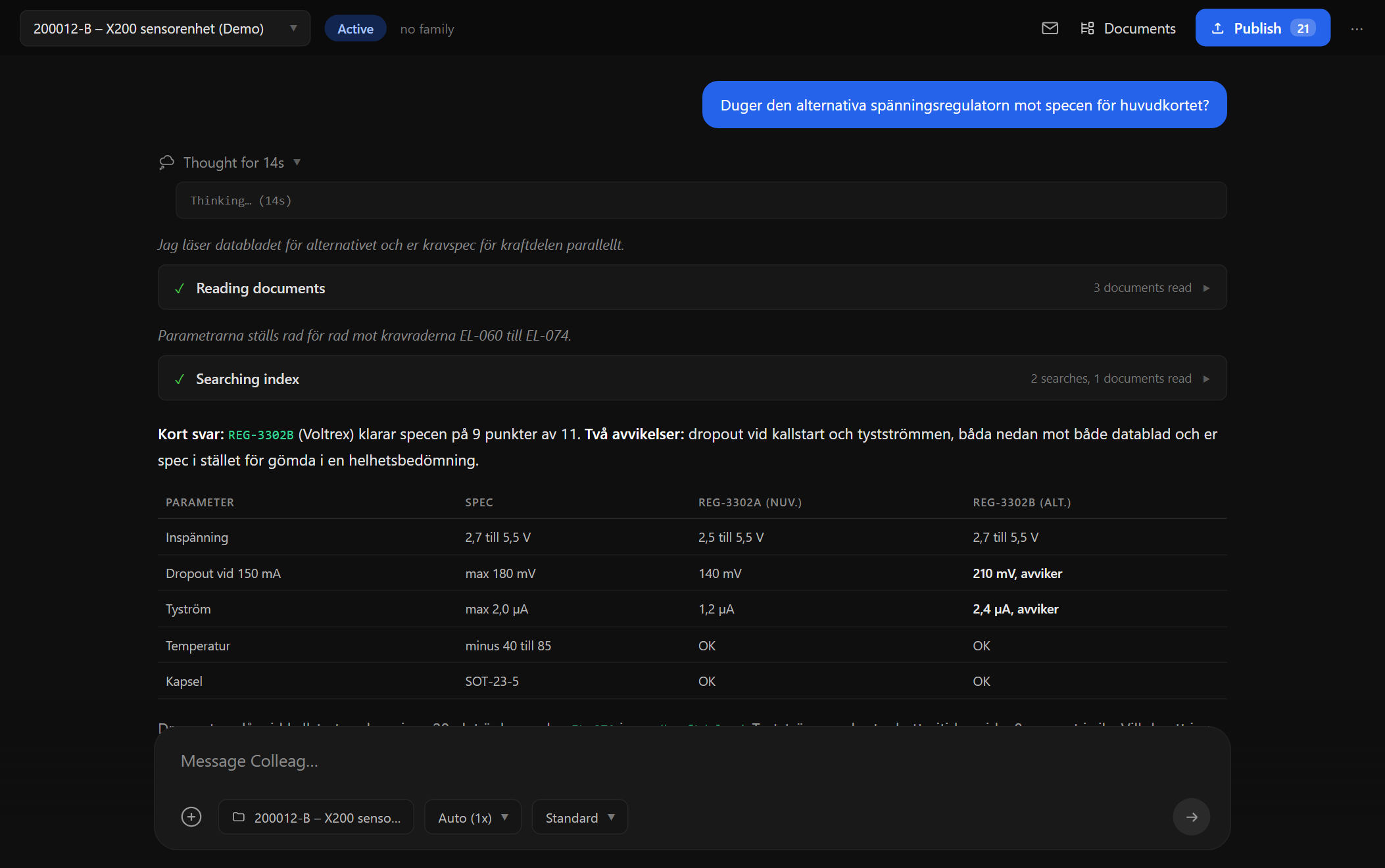
Screenshot from Colleag. The example uses invented figures.
The material
- The component's datasheet
- Your requirement spec in the workspace
- Design documentation for the board
You approve
Everything the colleague produces is a proposal with sources. Nothing is published, sent or saved to the archive without a human approving it, and every figure traces to its material.
Curious what it feels like?
We run pilot programs with a few manufacturing companies at a time. Tell us about your business and we will show what the colleagues can do with your documents and your data.